In modern digital ecosystems, organizations depend on multiple IT domains — applications, networks, cloud environments, and security frameworks — each managed by specialized teams. But these teams often work in isolation, using separate tools and data silos. As a result, incidents take longer to resolve, insights remain fragmented, and accountability becomes unclear.
Understanding Automated Observability
Automated observabilityis the next evolution of monitoring — one that uses AI and automation to collect, analyze, and correlate metrics, logs, and traces across systems.
It eliminates the manual effort of connecting the dots between alerts and root causes, providing unified context for every event in real time.
The Silo Problem: Why Traditional IT Operations Struggle
When each IT team uses its own tools, processes, and dashboards, the organization suffers from:
Fragmented data visibility Duplicate investigations Alert fatigue and missed dependencies Blame culture instead of a solution focus
How Automated Observability Bridges Cross-Functional Teams Automated observability creates a shared data fabric where all teams can view the same insights in real time. Key enablers include:
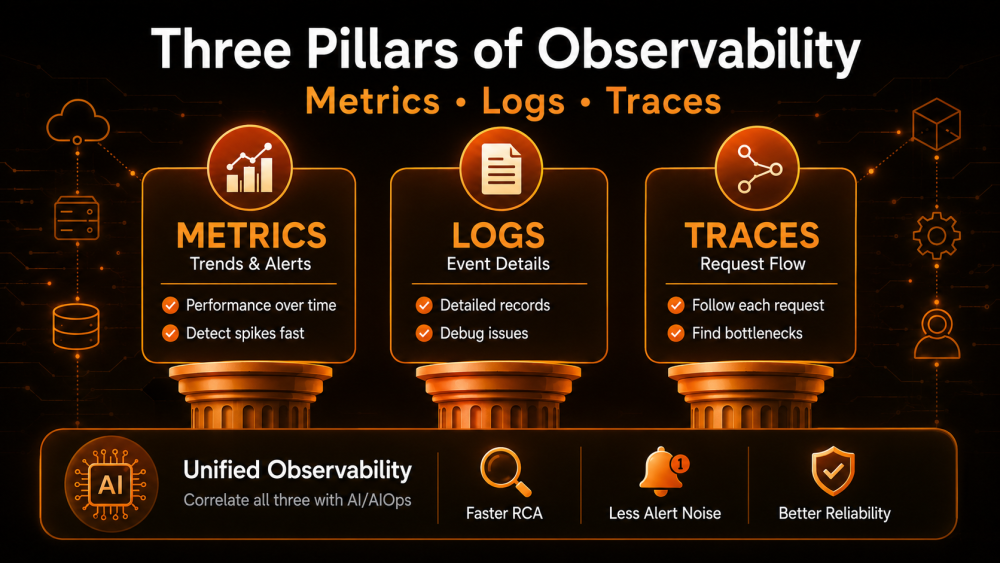
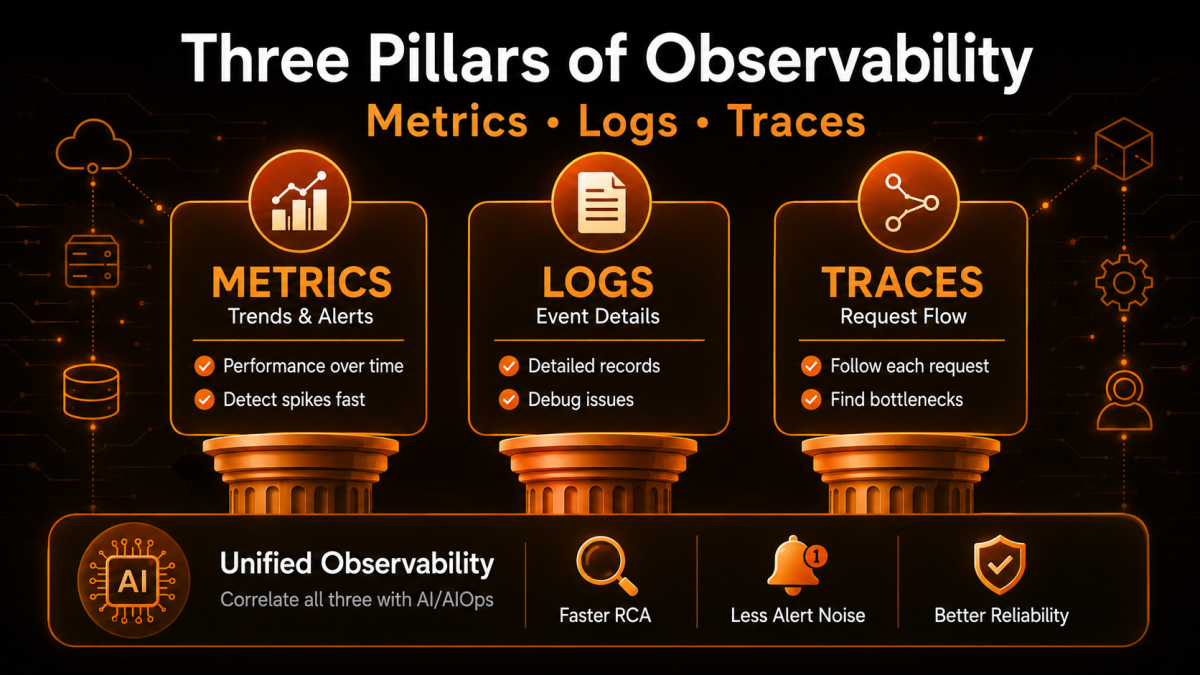
Unified Data Correlation: AI links events across logs, metrics, and traces.
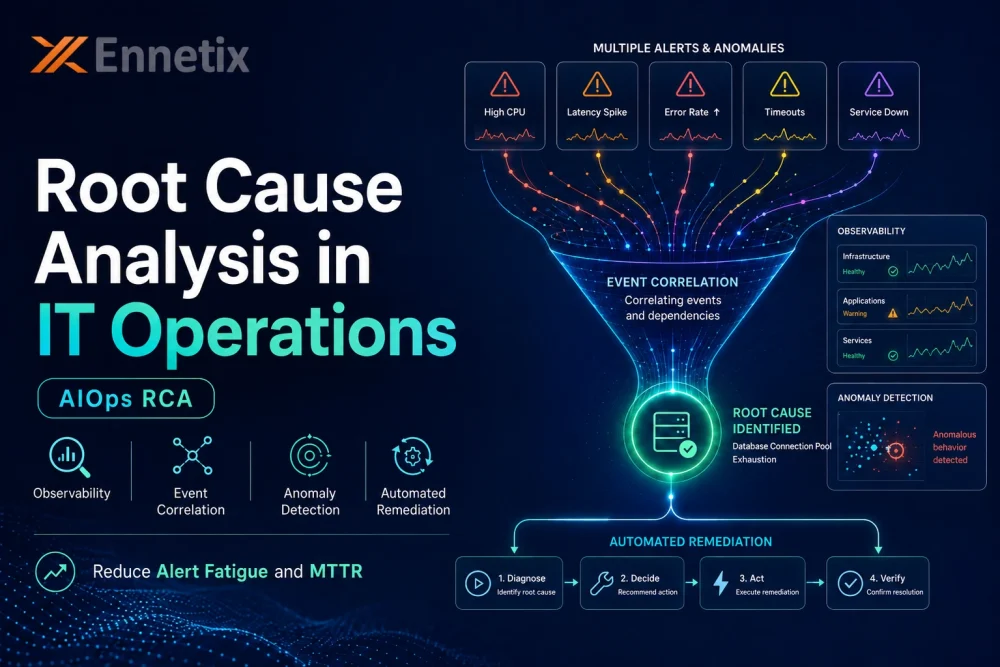
Real-Time Context: Dashboards provide one view for all stakeholders. Collaborative RCA: Root causes are identified and validated automatically. Alert Deduplication: Related alerts are grouped to reduce noise and improve focus. The Role of AIOps in Driving Automation and Collaboration AIOps (Artificial Intelligence for IT Operations) adds intelligence to observability by automating:
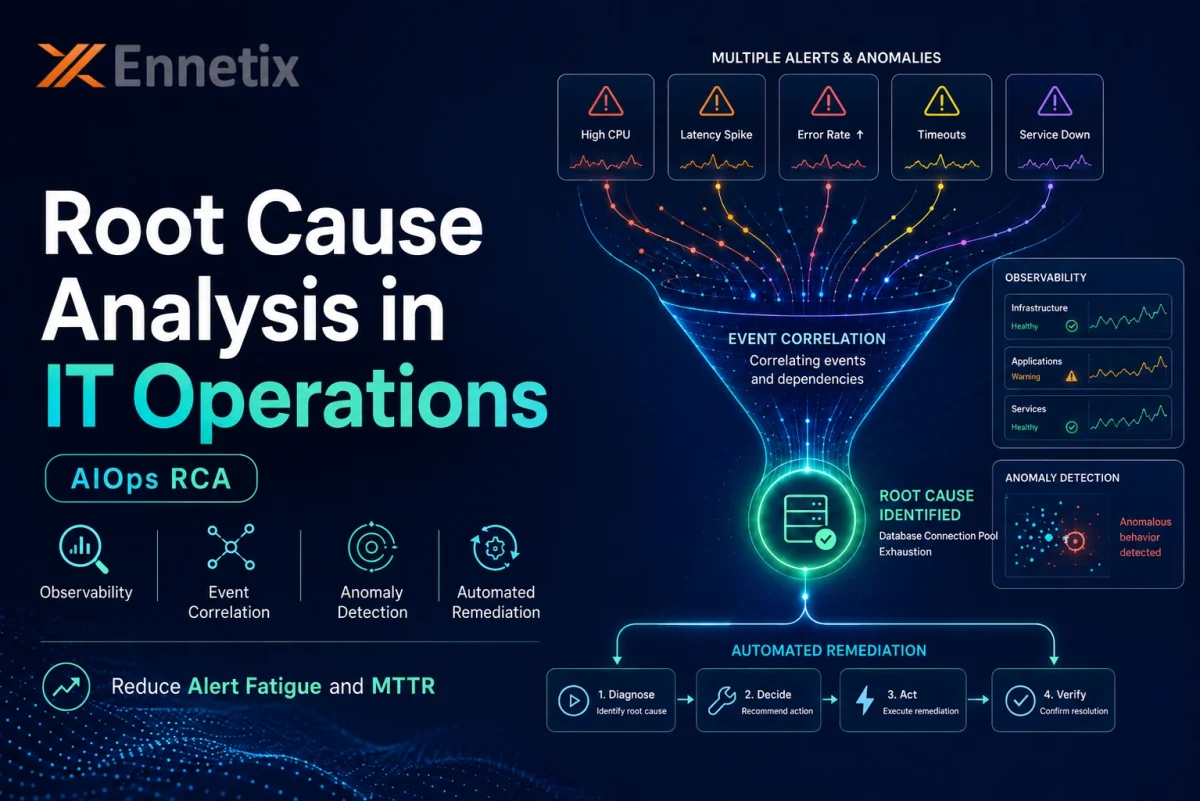
Event correlation and noise reduction
Predictive analytics for potential failures
Automated root cause identification
Intelligent remediation recommendations
Real-World Example – Resolving Incidents with Unified Observability
Imagine a global manufacturing company facing intermittent downtime in its production systems.
The DevOps team believes the issue is related to a software update.
The network team suspects packet loss.
The security team flags potential unauthorized access.
Using an automated observability platform, telemetry from all sources is correlated. The system detects that a misconfigured load balancer caused the bottleneck, impacting API calls across departments. All teams view the same RCA dashboard, confirm the cause, and fix the issue collaboratively — within minutes.
Implementation Framework – Building Collaborative Observability
To adopt automated observability effectively:
Unify Telemetry: Integrate metrics, logs, and traces from all systems.
Automate Correlation: Deploy AI-based event linking and RCA.
Centralize Dashboards: Give every team a shared visibility layer.
Define Workflows: Create joint playbooks for incident response.
The Future – From Collaboration to Autonomous Operations
As AIOps evolves, organizations will move beyond collaboration toward self-healing and autonomous operations. Future observability systems will:
Predict issues before they occur.
Recommend remediation automatically.
Initiate cross-team workflows without manual input
Conclusion – A Unified Vision for Modern IT Operations
Breaking down IT silos isn’t just a technological challenge — it’s a cultural transformation. Automated observability provides the foundation for shared visibility, faster incident resolution, and smarter decision-making across all IT functions. By combining observability with AIOps, organizations can transform from reactive responders into proactive innovators ready for the next generation of digital operations.
Jim Olson served as a Business Specialist at the Engineering Translational Technology Center (ETTC) at University of California, Davis, advising on company formation, strategy,and financing. He also taught classes as an Adjunct Faculty in the Graduate School of Management at UC Davis for over a decade. Previously, he was Executive Vice President of video compression systems at TANDBERG Television and CEO of SkyStream. At TANDBERG, he focused on building and marketing video compression offerings. Jim has held leadership roles at 3Com Corporation and Hewlett-Packard, where he led several successful product launches. He is an active angel investor and a guest lecturer at Stanford University and UC Davis. Jim holds a BSEE from UC Davis, and MSEE and MBA degreesfrom Santa Clara University.
Sudip Nandy is an acclaimed business leader with over 30 years of experience in global strategy, enterprise building, and investments. He is currently a Senior Advisor and has previously served as Managing Director and Operating Partner at ChrysCapital, a leading investment firm. He was Executive Chairman of Infogain Corporation and Board Member at Liquid Hub Inc. Sudip is also a Director on the Board of GeBBS Healthcare. Earlier, he was CEO and Chairman (India) for Aricent. He is the former Chief Strategy Officer and Head of M&A at Wipro, where he led several successful mergers and acquisitions. Sudip holds a Bachelor’s Degree in Physics from the Indian Institute of Technology (IIT), Kharagpur, andanother in Electrical Technology and Electronics from the Indian Institute of Science (IISc),Bengaluru. He also has an MBA from the Indian Institute of Management (IIM), Ahmedabad.
Prem Jain was CEO and Co-Founder of Pensando Systems, a cloud and enterprise data center startup, which was founded in 2017 and acquired by AMD in 2023. Before Pensando, Prem spent 23 years at Cisco Systems, where he was known as the “heart, soul, and brains” behind several successful startups. As the Senior Vice President and General Manager of Insieme BU, he developed Software Defined Networking (SDN/ACI) products and next-generation data-center switches. Prem joined Cisco in 1993 after it acquired Crescendo Communications, where he was Vice President of Systems Architecture. He holds a B.E. from Birla Institute of Technology and Science (BITS), Pilani, and a Master’s in Electrical and Computer Engineering from University of California, Davis.
CHIEF PRODUCT OFFICER (ACTING)
Ashok Madanahalli
Ashok Madanahalli brings 30+ years of experience in networking and cybersecurity at industry leaders such as Riverbed, Check Point, Extreme Networks, and FORE Systems where he built and led high-performance teams delivering product and market share leadership. At Riverbed, Ashok served as Vice President of Product Management (WAN Optimization and SD-WAN) leading the business transformation to Cloud and SaaS. He has also led Firewall/VPN/UTM and IDS/IPS solutions. Ashok holds a master’s degree in engineering from University of Oklahoma and a bachelor’s degree from National Institute of Technology, Durgapur, India.
FOUNDER AND DIRECTOR OF ENGINEERING
Trevor Gudmundsen
Trevor leads Ennetix’s efforts on full-stack design and development of the company’s analytics pipeline. He manages the operations of Ennetix platforms across its customer base.
Todd pioneered the field of network security monitoring in the 1990s with the development of the first widely deployed intrusion detection system, the Network Security Monitor (NSM). In addition to network-based security, he has developed intrusion detection sensors for Windows, Linux, and macOS. Todd is currently focused on bringing innovative network and endpoint security monitoring solutions to Ennetix’s xVisor platform.
Pulak Chowdhury, Founder and CTO, Ph.D., Computer Science, UC Davis
Pulak brings a unique combination of deep networking technology background with advanced research work in Computer Sciences. He provides overall architectural direction and drivers the development activities on xVisor with a highly talented team.
Prof. Dr. Bis Mukherjee, Founder and President (also Distinguished Professor, UC Davis), Ph.D., Electrical Engineering, University of Washington, Seattle, B.Tech. (Hons.), Electronics Engineering, Indian Institute of Technology, Kharagpur
Acknowledged authority in pioneering network technologies for 35+ years. His pioneering contributions in the networking world include:
Network Intrusion Detection System (1990)
Firewall (1989)
Dynamic bandwidth allocation for EPON/FTTH (2002)
Optical-wireless integration (2007), now 5G Fronthaul