
AIOps for Universities: How Unified Observability Is Transforming Campus IT Infrastructure
April 8, 2026
Agentic AI in Campus IT Operations: Opportunity, Risk, and What University Teams Need to Know in 2026
April 20, 2026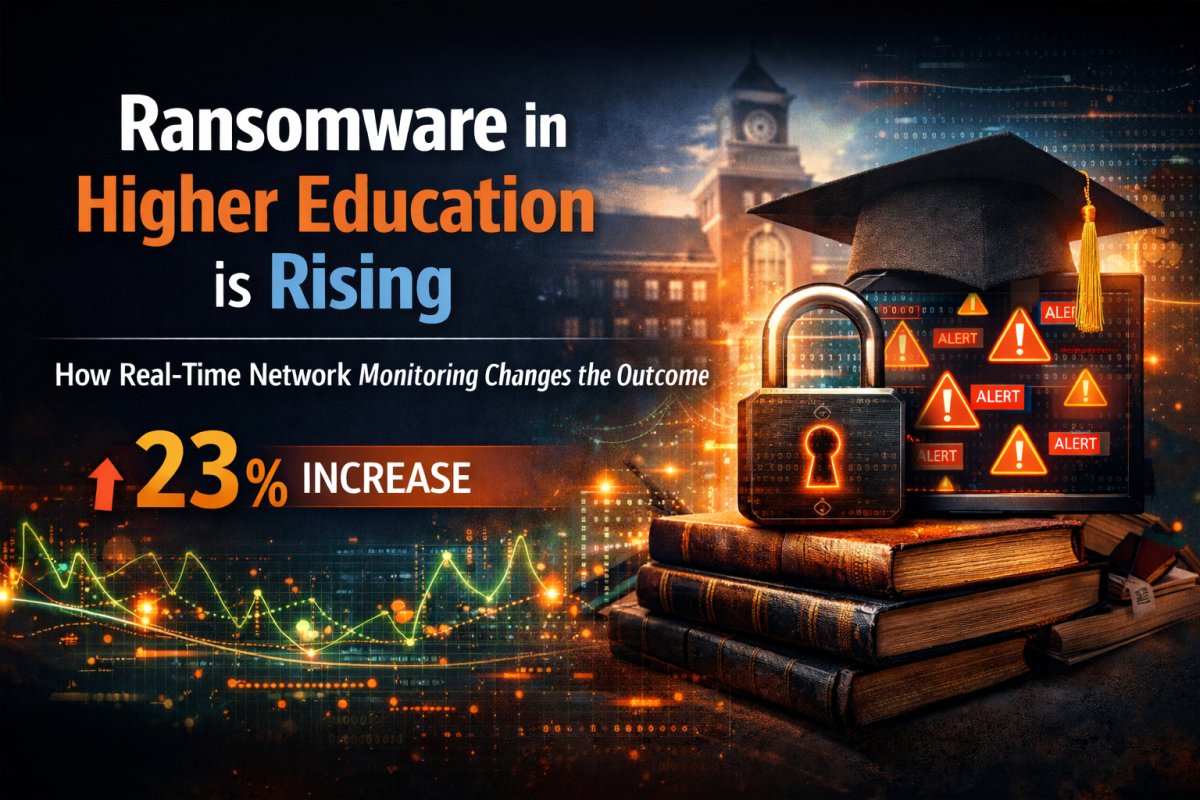
An 23 % Increase That Every University IT Team Should Know About
In the first half of 2026, ransomware attacks against educational institutions rose 23% compared to the same period the previous year, according to research by Comparitech. That six-month window saw 130 confirmed and unconfirmed attacks with an average ransom demand of $556,000. Education is now the fourth-most-targeted sector globally — behind only business, government, and healthcare.
These are not small incidents with contained consequences. In March 2025, the Cherokee County School District suffered an attack that compromised 46,000 users, locked systems for a week, and resulted in 624 gigabytes of data exfiltration. In Japan, Tokai University experienced a breach affecting nearly 100,000 students and staff during a critical academic period. Lincoln College — a 157-year-old institution — was forced to close permanently after a 2021 cyberattack blocked access to admissions data for months into the following year.
Education: 4,388 weekly cyberattacks per institution — the most attacked sector globally in 2025 (DeepStrike research)
The pattern that emerges from incident analysis is consistent: universities are targeted precisely because they are, in the language of CISA’s K-12 Cybersecurity Initiative, “target-rich and cyber-poor.” They hold enormous volumes of valuable data — research intellectual property, student records, health information, financial data — while operating with IT security budgets and team sizes that are a fraction of commercial organizations managing equivalent data volumes.
Why Universities Are Structurally Vulnerable
The structural factors that make universities attractive ransomware targets are the same factors that make university IT security challenging to implement. The attack surface is vast and inherently open: guest networks, personal student devices, research partner connections, remote faculty access, and an expanding fleet of smart campus IoT devices all represent potential entry points that cannot be managed through traditional perimeter security approaches.
Legacy systems compound the exposure. Research from Bitsight found that 45% of all universities have at least one asset running end-of-life PHP, and approximately 10% have open RDP ports — the same vector that provided initial access in 70-80% of data breaches according to the FBI. The education sector averages 151 days to remediate known exploited vulnerabilities, compared to the technology sector’s significantly faster remediation pace. In a threat environment where attackers routinely exploit vulnerabilities within days or weeks of disclosure, this remediation gap represents extended windows of exposure.
The 2025 evolution of ransomware tactics has added another dimension of risk. According to Sophos research, the percentage of higher education attacks stopped before data was encrypted jumped from 21% to 38% in 2025 — institutions are getting better at blocking encryption. But data exfiltration is rising in parallel. Attackers are increasingly bypassing the encryption phase and moving directly to exfiltration and extortion, stealing data and threatening to publish it publicly to damage institutional reputation and relationships.
The Detection Gap: Why Signature-Based Security Is Not Enough
The challenge for university security teams is not a lack of security tools — most institutions have firewalls, antivirus, and some form of network security monitoring. The challenge is detection speed. Ransomware and data exfiltration attacks that succeed do so because they evade signature-based detection long enough to establish a foothold, move laterally through the network, and reach their targets.
Behavioral anomaly detection — identifying network activity that deviates from established baselines rather than matching known attack signatures — provides the early warning capability that signature-based tools cannot. When a user account begins accessing file shares it has never accessed before, when network traffic from a research computing cluster begins flowing to an unexpected external destination, when lateral movement patterns consistent with reconnaissance activity emerge in a campus network segment — these are the signals that indicate an attack in progress, detectable before encryption or exfiltration begins.
The critical question in ransomware defense is not whether detection tools can identify an attack — it is whether they can identify it early enough to contain it. Network-level behavioral monitoring provides the detection lead time that endpoint-only security cannot.
How Real-Time Network Monitoring Changes the Outcome
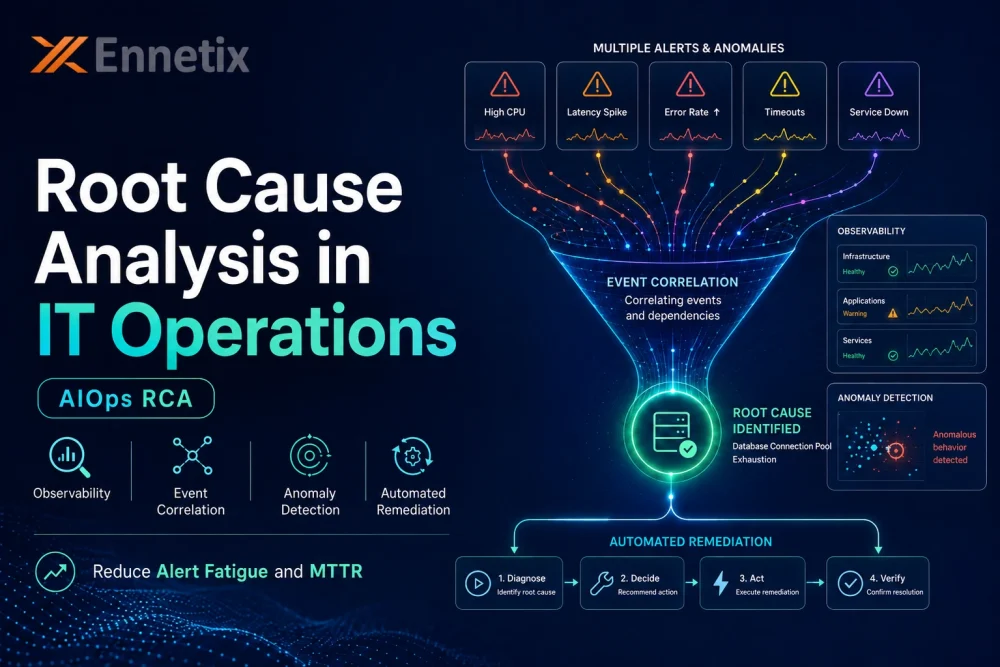
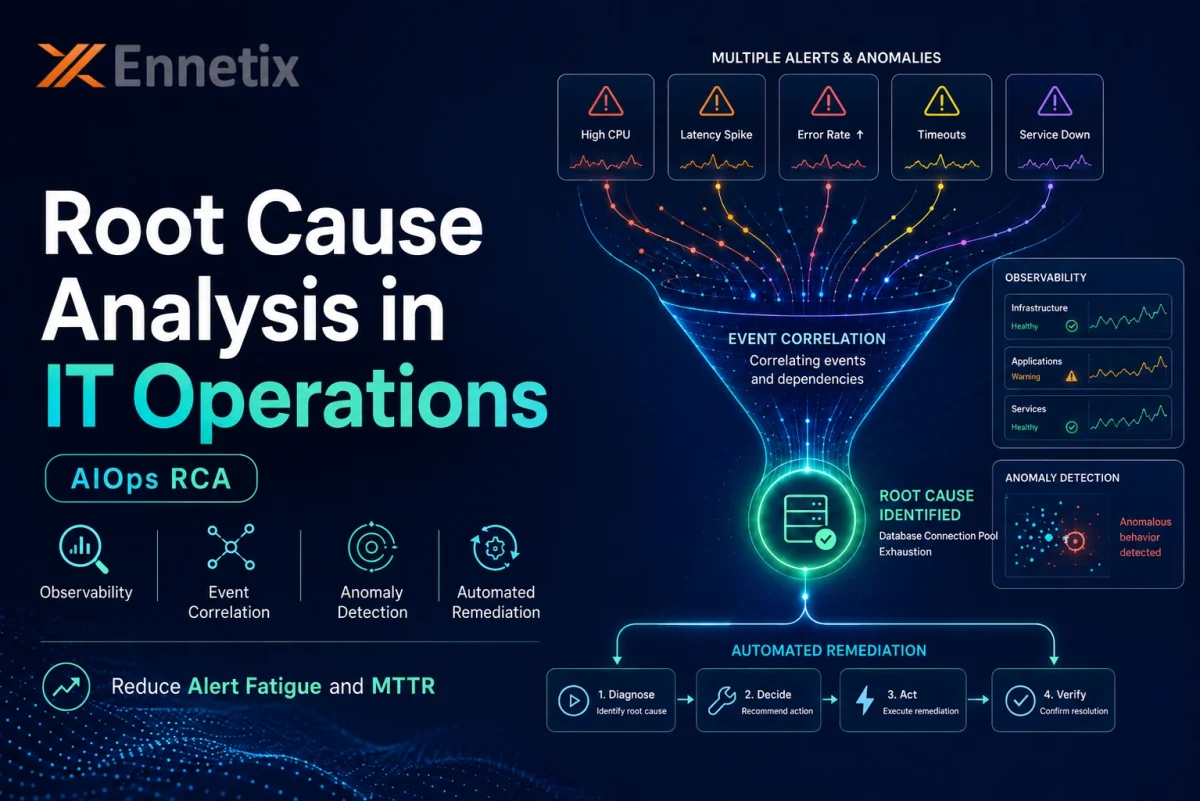
The Ennetix AIOps platform provides real-time network observability through XOME, which monitors traffic flows, service communications, and behavioral patterns across university network segments without requiring instrumentation of individual applications. When behavioral anomalies appear — unusual lateral movement patterns, unexpected high-volume data transfers, network connections to external destinations inconsistent with normal research activity — xVisor surfaces alerts with the contextual information needed to investigate and respond rapidly.
This network-level detection layer is complementary to, not a replacement for, endpoint security. The combination of network behavioral monitoring through XOME and endpoint visibility through xTend provides the multi-layer visibility needed to detect attacks across the full kill chain — from initial access through lateral movement to data staging and exfiltration. Each layer catches what the other might miss.
For a university security operations team managing a distributed campus environment with limited staffing, the practical impact is significant. Instead of investigating individual alerts from multiple siloed tools, the unified xVisor platform correlates network, endpoint, and application signals into a coherent investigation timeline. Security analysts spend less time on data gathering and more time on response — which is exactly the outcome that changes whether a ransomware event is a contained incident or an institutional crisis.
What Universities Can Do Now: A Practical Framework
Establish behavioral baselines before you need them
Anomaly detection requires baselines. Universities should implement continuous monitoring of normal traffic patterns across all network segments — campus, residential, research, administrative — so that deviations from normal are detectable. Baselines that account for the extreme traffic variability of academic calendars (exam periods, semester starts, research computing peaks) are essential for avoiding false positives that erode trust in the alerting system.
Prioritize lateral movement detection
The dwell time between initial access and data exfiltration in most ransomware attacks is measured in hours to days. During this period, attackers move laterally through the network looking for high-value targets. Network monitoring that specifically tracks and alerts on unusual internal traffic patterns — particularly connections between network segments that do not normally communicate — provides the detection opportunity during this dwell phase.
Integrate security and IT operations monitoring
Security incidents and IT performance events frequently appear as correlated anomalies in monitoring data before they are identified as distinct events. Integrated monitoring platforms that allow security and IT operations teams to share a common operational picture reduce both detection time and the coordination overhead of inter-team incident response.
The Stakes Are Institutional, Not Just Technical
Ransomware in higher education is not simply a technology problem. The inability to process admissions during a peak window can cost an institution an entire year’s enrollment revenue. Exfiltration of research intellectual property can damage funding relationships, faculty recruitment, and industry partnerships built over years. The human toll — the 40% of higher ed IT leaders who reported heightened anxiety and stress, the 34% who felt significant guilt about being unable to prevent attacks (Sophos 2025) — reflects a sector under genuine operational pressure.
The institutions that invest in real-time, behavioral network monitoring now will be meaningfully better positioned when the next attack attempt comes. In a threat environment where the question is not whether an attack will be attempted but whether it will be detected early enough to contain, the quality of the monitoring infrastructure is the difference that matters most.
If your institution wants to assess its current network monitoring capability against the threat environment described in this post, the Ennetix team is glad to have that conversation.
FAQs
- Hold massive volumes of sensitive data (research IP, student records, financial info)
- Operate with limited IT security budgets and small teams
- Open networks (guest access, personal devices, IoT) create a huge attack surface
- Average 151 days to patch known vulnerabilities — far slower than other sectors
- Not anymore — attackers are skipping encryption and going straight to data theft
- Stopping encryption jumped from 21% to 38% in 2025, but exfiltration is rising in parallel
- Institutions need to catch threats earlier, before data ever leaves the network
- These tools rely on known threat signatures and miss new or evolving attack patterns
- Behavioral monitoring detects deviations from normal — unusual access, unexpected traffic, lateral movement
- Catches attacks during the dwell phase, before encryption or exfiltration begins
- Dwell time typically ranges from hours to days after initial access
- During this window, attackers move laterally to find high-value targets
- Early detection during this phase is the difference between a contained incident and a full breach