
Mean Time to Resolution Is Rising: What’s Slowing Down Modern IT Teams?
February 5, 2026
Ransomware in Higher Education Is Rising: How Real-Time Network Monitoring Changes the Outcome
April 14, 2026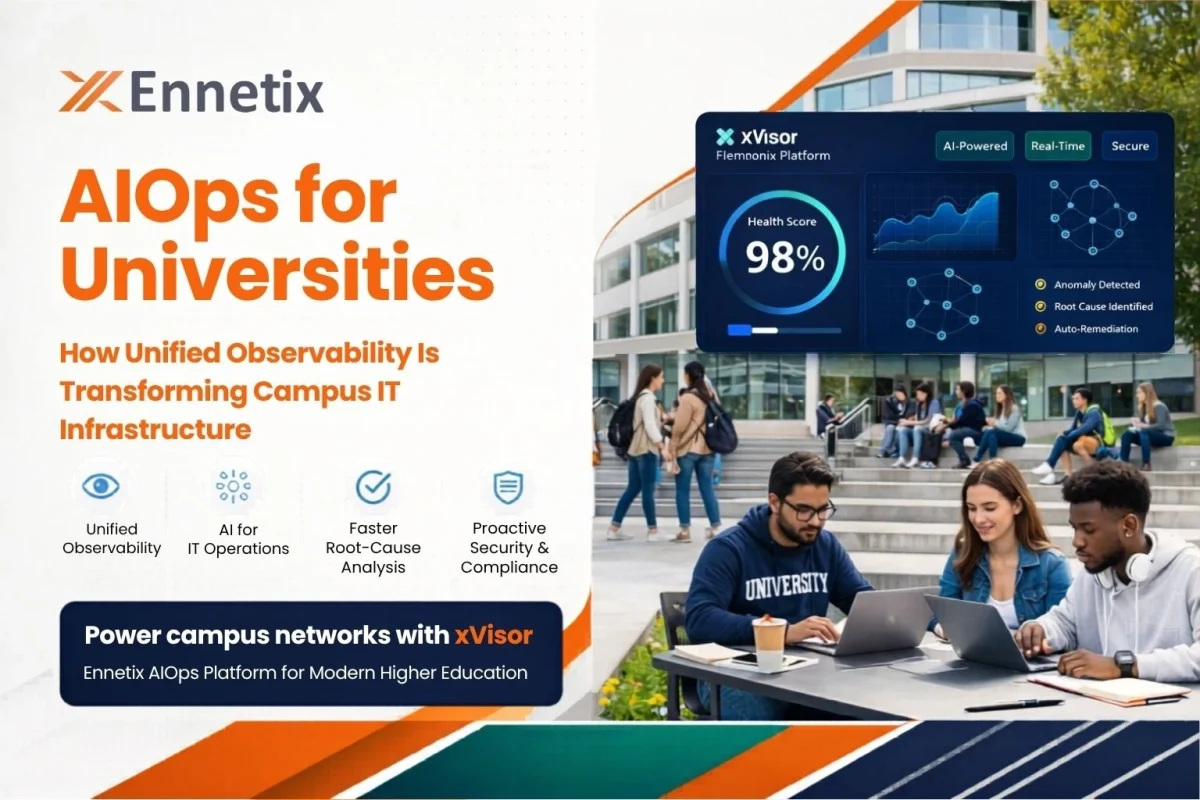
University IT environments are among the most complex in any sector. A single campus can host tens of thousands of students, thousands of faculty and staff, hundreds of simultaneous research projects, multiple data centres, cloud integrations, and an expanding fleet of IoT devices — all managed by an IT team that is perpetually understaffed relative to the infrastructure it maintains.
In the past five years, this complexity has intensified. Hybrid learning models have become permanent fixtures. Research workloads now involve petabyte-scale datasets and high-performance computing clusters with near-zero-latency requirements. Cybersecurity threats against academic institutions — ransomware attacks, data breaches targeting research intellectual property, credential-stuffing campaigns exploiting student accounts — have grown in frequency and sophistication.
Managing this environment with tools designed for a simpler era of IT is no longer viable. Unified observability powered by the Ennetix AIOps platform offers universities a fundamentally more effective approach: real-time visibility across the full IT stack, dramatically faster root-cause analysis, and the ability for learner IT teams to manage complex infrastructure with genuine confidence.
The Unique Challenges of University IT Environments ?
University IT is structurally different from enterprise IT in ways that matter deeply for how infrastructure is monitored and managed.
Distributed Campuses and Fragmented Infrastructure
A large university is not one network — it is hundreds. Lecture halls, student residences, administrative buildings, research campuses, medical centres, sports facilities, and partner institutions all have their own network segments, often managed by different teams using different toolsets. Monitoring this distributed landscape requires a platform that aggregates and correlates data from heterogeneous sources without sacrificing the granularity needed to diagnose issues in specific segments.
Extreme Variability in User and Traffic Patterns
Traffic patterns on a university network are unlike anything in commercial IT. Exam periods create sudden, sustained peaks on learning management systems. Research workloads generate burst traffic that can saturate specific network paths for hours. Freshers week produces massive registration spikes. Social events fill campus networks in ways that can be indistinguishable from distributed denial-of-service patterns. Monitoring tools calibrated to commercial baselines misread these patterns constantly, producing false positives that erode trust in the alerting system.
Research Network Complexity
Research networks carry workloads that are categorically different from administrative or educational traffic. High-performance computing clusters process genomic datasets, physics simulations, and climate models that require coordinated compute and storage performance. Degraded network connectivity at a critical point in a multi-hour computation can corrupt results and waste significant resources. These workloads demand monitoring at a granularity that general-purpose tools rarely provide.
Escalating Cybersecurity Threats
Academic institutions have become high-priority targets for cybercriminals and state-sponsored threat actors. Universities hold research intellectual property of significant commercial and national security value. Student and staff records contain sensitive personal data. Healthcare-affiliated academic medical centres process clinical information under strict regulatory requirements. The attack surface is vast — open networks, personal devices, international research collaborations — and effectively impossible to fully perimeter-protect.
Why Traditional Monitoring Tools Fall Short
Most university IT environments have accumulated monitoring tools organically over years: a network performance monitoring tool here, a security information and event management platform there, an application performance monitoring solution for the learning management system, separate tooling for the research data centre. Each tool does its job within its domain. None of them provides the end-to-end picture that effective management requires.
A Director of Network Operations at a leading US university described it this way: “We have often said, your product is first-rate and revolutionary. It has been a pleasure to work with you and your team to actualize on the vision.” That comment came after replacing three siloed tools with a unified observability platform.
The consequences of fragmentation are concrete and costly. Alert fatigue sets in as multiple monitoring tools independently raise alarms for correlated events. Root-cause analysis requires manual correlation across tools, consuming hours of senior engineer time for problems that should be diagnosable in minutes. Proactive detection — identifying a developing problem before it impacts users — is effectively impossible when monitoring data is siloed.
What Unified Observability Actually Means for Universities
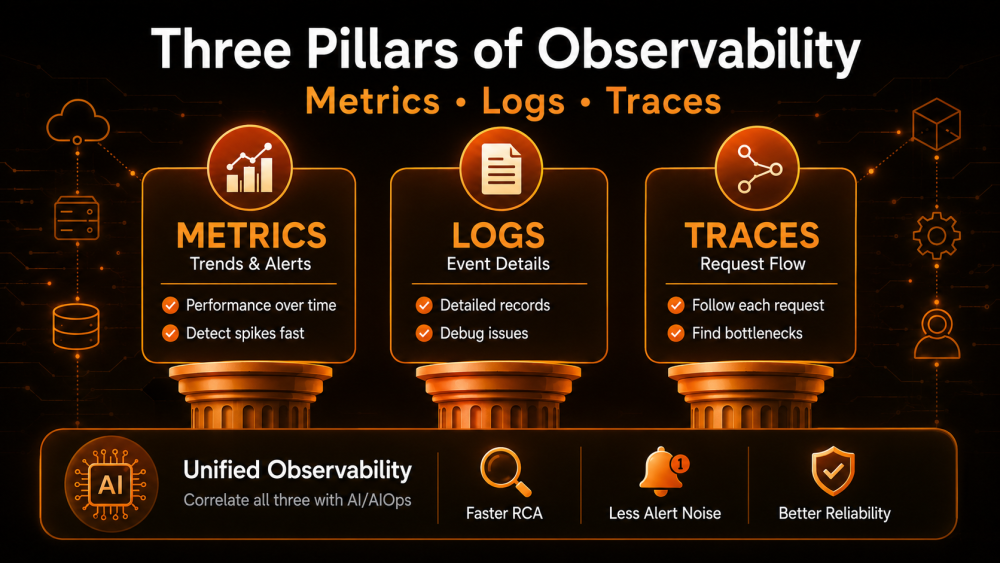
Unified observability is not simply a matter of collecting monitoring data into a single dashboard. It is the capability to understand causal relationships between events across different layers of the IT stack — network performance, application behaviour, endpoint activity, security events — and surface that understanding in a form that enables fast, confident decisions.
For a university IT team, this means being able to answer a critical question in real time: is the student who cannot access the learning management system experiencing a network capacity issue, an application performance problem, an endpoint configuration error, or a security event? Answering that question correctly, quickly, is the difference between a two-minute fix and a two-hour investigation.
The Ennetix AIOps platform delivers this capability through a combination of network-level monitoring (XOME), endpoint-level visibility (xTend), and cloud-level analytics (xVisor). Together, these components provide the inside-out and outside-in perspective that comprehensive observability requires.
The Role of AIOps in Higher Education IT
Predictive Analytics for Proactive Management
AIOps platforms analyse historical patterns in infrastructure behaviour to identify anomalies before they produce user-visible symptoms. For a university network, this means detecting that traffic patterns on a specific campus segment are trending toward saturation three hours before students start experiencing slow connectivity — giving the network team time to act, not react. Predictive analytics transforms IT operations from a perpetually reactive discipline into a genuinely proactive one.
Automated Root-Cause Analysis
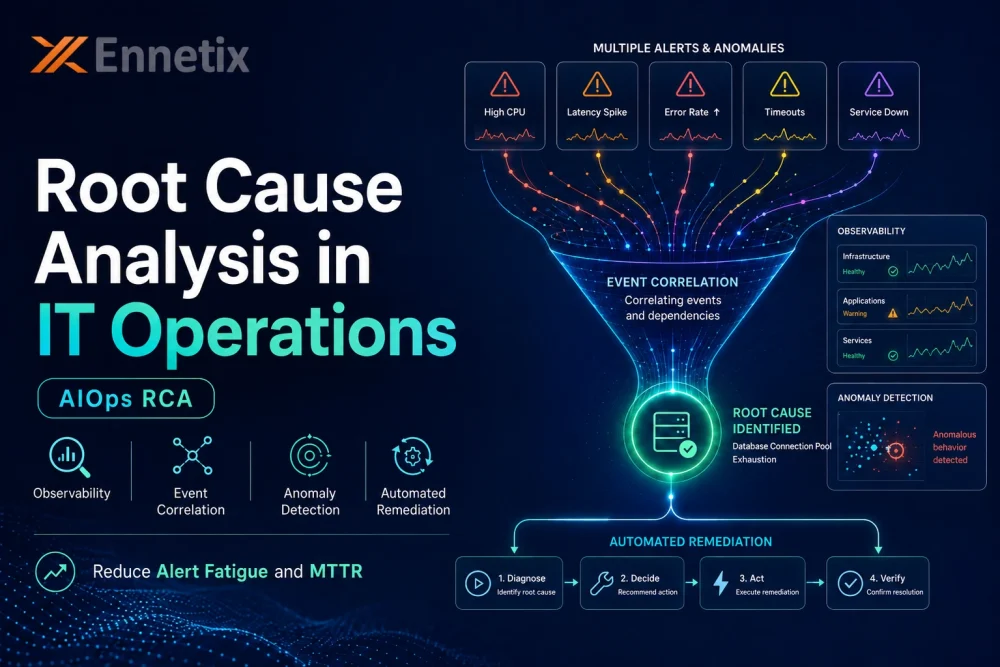
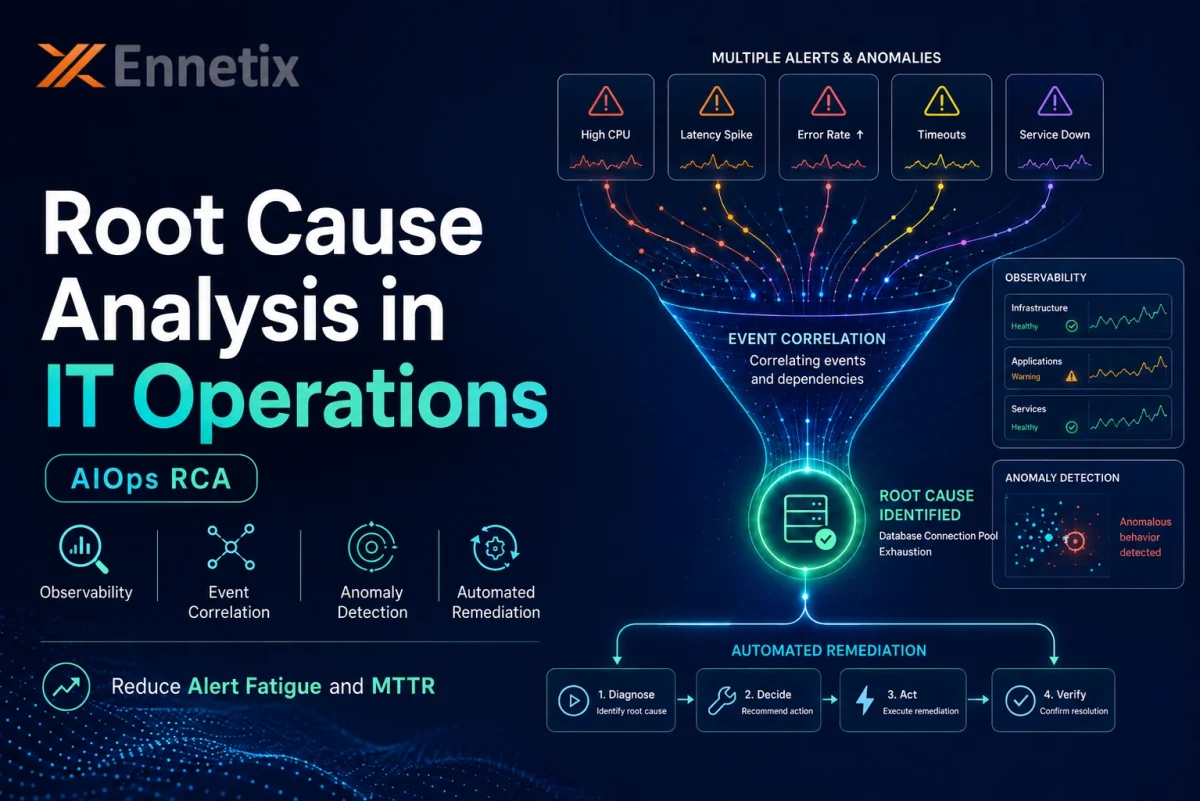
When incidents occur, automated root-cause analysis dramatically reduces the time from alert to resolution. The Ennetix AIOps platform correlates events across network, application, and endpoint layers to establish the causal chain between an infrastructure event and its observable symptom. Instead of three engineers from three teams spending two hours manually correlating alerts, one engineer has a diagnosis in minutes.
AI-Driven Anomaly Detection for Security
Real-time anomaly detection is a critical cybersecurity capability for academic institutions. Machine learning models trained on normal traffic baselines can identify deviations that indicate ransomware propagation, data exfiltration, compromised credential use, or lateral movement — often before signature-based detection tools register any signal. For research institutions where early detection can mean the difference between a contained incident and catastrophic data loss, this capability is essential.
Key Benefits for University IT Teams
Improved Uptime for Learning and Research Systems
Downtime on a learning management system during exam period is not just an IT problem — it is a student welfare issue with potential academic and reputational consequences. Proactive monitoring and rapid root-cause analysis reduce both the frequency and the duration of outages, protecting the academic experience that institutions exist to deliver.
Optimised Resource Management for Lean Teams
University IT teams are consistently asked to do more with fewer resources. Unified observability reduces the time senior engineers spend on routine triage, freeing capacity for strategic infrastructure improvements. Automated anomaly detection reduces the alert fatigue that leads to missed signals and analyst burnout.
Stronger Security and Compliance Posture
Research institutions managing government grants and industry partnerships face increasing regulatory scrutiny of data security practices. Comprehensive monitoring, audit logging, and incident investigation capabilities support compliance with frameworks including NIST, HIPAA for medical research affiliates, and data protection regulations applicable to international research collaborations.
Use Cases: How Universities Apply Unified Observability
Campus-Wide Network Monitoring
Monitoring traffic flows across distributed campus segments, detecting capacity issues before they impact users, identifying security anomalies in residential networks where personal device risk is highest, and providing the network operations team with a single, unified view of infrastructure across all buildings and locations.
Online Learning Platform Assurance
Monitoring the end-to-end experience delivered to students accessing learning management systems, video conferencing platforms, and course content delivery — correlating network performance, application performance, and user experience metrics to identify and resolve degradation proactively rather than in response to helpdesk escalations.
Research Infrastructure Performance
Providing granular visibility into high-performance computing cluster performance, research data transfer speeds, and the network paths connecting research campuses to external collaborators and cloud platforms. Detecting performance degradation in research workflows early enough to prevent loss of computation time and research continuity.
Security Incident Detection and Investigation
Correlating network anomalies, endpoint behaviour, and application events to detect security incidents in context — providing the security team with the multi-layer evidence needed to understand the scope, nature, and origin of an incident from a single investigation interface rather than across multiple siloed tools.
The Future of IT in Higher Education
The trajectory of university IT is clear: more distributed, more data-intensive, more dependent on high-performance connectivity, and more exposed to sophisticated cyber threats. AI-driven campuses, where building management, access control, research instrumentation, and educational delivery are all interconnected, require observability platforms capable of monitoring and securing the full extent of that integration.
Universities that build a strong AIOps observability foundation now will be significantly better positioned to manage growing complexity. Those that continue with fragmented tooling will face an increasingly difficult challenge as the gap between monitoring capability and infrastructure complexity widens — and as the student and faculty expectations for digital experience continue to rise.
Conclusion: Building the Foundation for Intelligent Campus IT
University IT environments have never been more complex, and the teams managing them have never been under greater pressure. Unified observability — the ability to see, understand, and act on what is happening across the full IT stack in real time — is the foundational capability that modern academic institutions need to manage their infrastructure effectively, protect research and student data, and deliver the high-quality digital experience that students, faculty, and research partners expect.
The Ennetix AIOps platform was built with these challenges in mind. Universities and research institutions are among our earliest and most committed customers — because the problems we solve are the problems their IT teams live with every single day. If your institution is evaluating how to modernise its IT observability approach, we would be glad to start that conversation.
FAQs
AIOps (Artificial Intelligence for IT Operations) combines AI and machine learning with IT management to automate monitoring, detect anomalies, and resolve issues proactively. A good observability platform can predict an impending system failure before it causes a large-scale outage, and should also provide notifications when there is degradation in performance impacting user experience and productivity. Ennetix For universities managing sprawling campus networks — supporting students, faculty, research systems, and administrative tools simultaneously — this kind of predictive intelligence is essential to maintaining uptime and performance.
With AI at its core, platforms like Ennetix's xVisor predict potential disruptions before they escalate — for example, if a spike in latency suggests an impending outage, the platform notifies the team to act swiftly. Ennetix Additionally, AI/ML capabilities better equip ops teams to eliminate false positives and reduce alert fatigue Ennetix, allowing campus IT staff to focus on genuine issues rather than chasing noise.
Unified observability is a strategic approach that brings together telemetry data — metrics, logs, traces, events, and user insights — from across the IT ecosystem into a single, correlated, and actionable view. Ennetix For universities, this means getting visibility across Wi-Fi networks, data centers, cloud applications, student portals, and research infrastructure all from one platform, rather than juggling multiple disconnected monitoring tools.