Modern IT environments are more complex than ever. Hybrid infrastructure, cloud-native applications, distributed users, third-party integrations, and evolving threat landscapes have created an ecosystem where even minor disruptions can cascade into major incidents. When something goes wrong, teams often scramble to respond. But a critical question remains:
What actually breaks first in an IT environment—visibility, performance, or security?
Understanding this sequence is essential for improving operational resilience, reducing downtime, and preventing security incidents before they escalate.
The Interconnected Nature of Modern IT Systems
In traditional IT setups, monitoring focused on individual components—servers, networks, or applications. Today, systems are deeply interconnected. A performance issue in one layer can obscure visibility elsewhere, while a lack of visibility can delay detection of a security breach.
This interconnectedness means failures rarely happen in isolation. Instead, they follow a pattern—one capability weakens first, triggering failures across others.
1. Visibility Breaks First: The Silent Failure
In most organizations, visibility is the first capability to degrade, often without immediate notice.
Why Visibility Fails Early
Tools sprawl across networks, applications, endpoints, and cloud platforms.
Siloed dashboards that do not correlate data.
Delayed or incomplete telemetry.
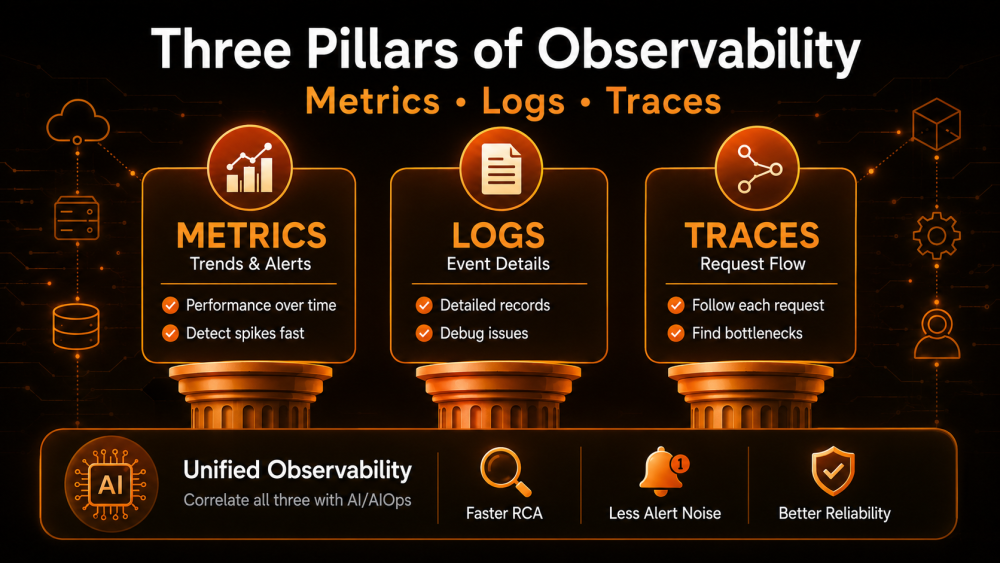
Lack of context between events, metrics, logs, and traces.
When visibility breaks, IT teams lose the ability to see the full picture. Alerts may still trigger, but they arrive without context. Signals appear disconnected. Root causes remain hidden.
2. Performance Degrades Next: Symptoms Without Answers
Once visibility weakens, performance issues surface more frequently and last longer.
Common Performance Symptoms
Increased application latency.
Intermittent outages.
Degraded user experience.
SLA breaches.
Escalation of IT incidents.
At this stage, IT teams often respond reactively. They know something is wrong, but they do not know why. Manual troubleshooting becomes the norm, increasing mean time to detection and resolution.
Why Performance Suffers
Issues are detected late.
Dependencies between systems are not mapped.
Alerts are noisy and lack prioritization.
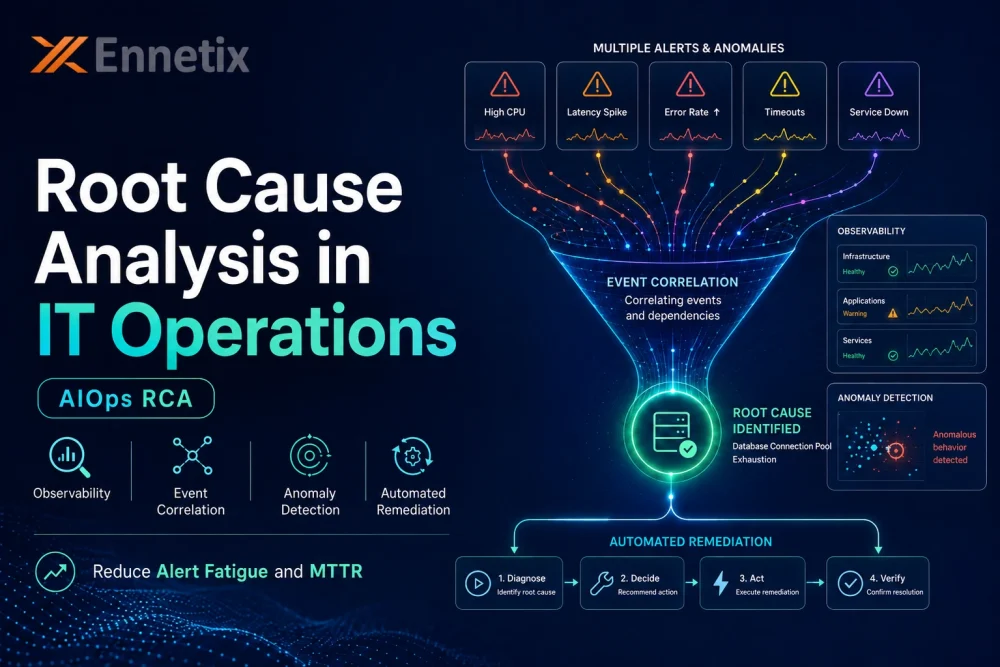
Root cause analysis is slow or inaccurate.
Performance problems are not always the root issue—they are often the visible outcome of broken visibility.
3. Security Breaks Last—but Hits the Hardest
Security is rarely the first thing to break, but when it does, the consequences are severe.
How Security Becomes Vulnerable
Anomalous behavior goes unnoticed due to lack of context.
Performance anomalies mask malicious activity.
Security alerts are buried in operational noise.
Threat indicators are not correlated with operational data.
By the time security teams detect an incident, attackers may have already moved laterally or exfiltrated data.
The Root Problem: Fragmented IT Operations
The recurring issue across visibility, performance, and security is fragmentation.
Monitoring tools operate independently.
Security platforms lack operational context.
Operations teams work in silos.
Alerts are reactive rather than predictive.
This fragmentation prevents teams from understanding how events in one domain impact another.
Why Unified Observability Changes the Outcome
Organizations that adopt unified observability and AI-driven IT operations experience a different failure pattern.
Instead of visibility breaking first, they gain:
Continuous, correlated insight across infrastructure, applications, networks, and users.
Real-time and predictive anomaly detection.
Automated root cause analysis.
Faster remediation with fewer manual interventions.
This approach shifts IT teams from reactive firefighting to proactive prevention.
From Reactive IT to Predictive Operations
When visibility, performance, and security are treated as separate disciplines, failures cascade. When they are unified, issues are detected earlier, resolved faster, and prevented altogether.
Key outcomes include:
Reduced downtime.
Improved digital experience assurance.
Stronger security posture.
Better operational decision-making.
How Ennetix xVisor Addresses This
Ennetix xVisor approaches visibility, performance, and security as a single, interconnected problem rather than separate domains.
By unifying telemetry across infrastructure, applications, networks, and user experience, Ennetix xVisor restores visibility before performance degrades or security gaps emerge. Correlated insights help teams understand dependencies early, reducing blind spots that typically cause cascading failures across performance and security layers.
Final Thoughts
So, what breaks first in your IT environment?
In most cases, it is visibility—quietly and gradually. Performance follows as symptoms emerge. Security breaks last, but with the highest cost.
The organizations that succeed are those that recognize this sequence early and invest in unified, intelligent observability that connects performance and security insights in real time.
Jim Olson served as a Business Specialist at the Engineering Translational Technology Center (ETTC) at University of California, Davis, advising on company formation, strategy,and financing. He also taught classes as an Adjunct Faculty in the Graduate School of Management at UC Davis for over a decade. Previously, he was Executive Vice President of video compression systems at TANDBERG Television and CEO of SkyStream. At TANDBERG, he focused on building and marketing video compression offerings. Jim has held leadership roles at 3Com Corporation and Hewlett-Packard, where he led several successful product launches. He is an active angel investor and a guest lecturer at Stanford University and UC Davis. Jim holds a BSEE from UC Davis, and MSEE and MBA degreesfrom Santa Clara University.
Sudip Nandy is an acclaimed business leader with over 30 years of experience in global strategy, enterprise building, and investments. He is currently a Senior Advisor and has previously served as Managing Director and Operating Partner at ChrysCapital, a leading investment firm. He was Executive Chairman of Infogain Corporation and Board Member at Liquid Hub Inc. Sudip is also a Director on the Board of GeBBS Healthcare. Earlier, he was CEO and Chairman (India) for Aricent. He is the former Chief Strategy Officer and Head of M&A at Wipro, where he led several successful mergers and acquisitions. Sudip holds a Bachelor’s Degree in Physics from the Indian Institute of Technology (IIT), Kharagpur, andanother in Electrical Technology and Electronics from the Indian Institute of Science (IISc),Bengaluru. He also has an MBA from the Indian Institute of Management (IIM), Ahmedabad.
Prem Jain was CEO and Co-Founder of Pensando Systems, a cloud and enterprise data center startup, which was founded in 2017 and acquired by AMD in 2023. Before Pensando, Prem spent 23 years at Cisco Systems, where he was known as the “heart, soul, and brains” behind several successful startups. As the Senior Vice President and General Manager of Insieme BU, he developed Software Defined Networking (SDN/ACI) products and next-generation data-center switches. Prem joined Cisco in 1993 after it acquired Crescendo Communications, where he was Vice President of Systems Architecture. He holds a B.E. from Birla Institute of Technology and Science (BITS), Pilani, and a Master’s in Electrical and Computer Engineering from University of California, Davis.
CHIEF PRODUCT OFFICER (ACTING)
Ashok Madanahalli
Ashok Madanahalli brings 30+ years of experience in networking and cybersecurity at industry leaders such as Riverbed, Check Point, Extreme Networks, and FORE Systems where he built and led high-performance teams delivering product and market share leadership. At Riverbed, Ashok served as Vice President of Product Management (WAN Optimization and SD-WAN) leading the business transformation to Cloud and SaaS. He has also led Firewall/VPN/UTM and IDS/IPS solutions. Ashok holds a master’s degree in engineering from University of Oklahoma and a bachelor’s degree from National Institute of Technology, Durgapur, India.
FOUNDER AND DIRECTOR OF ENGINEERING
Trevor Gudmundsen
Trevor leads Ennetix’s efforts on full-stack design and development of the company’s analytics pipeline. He manages the operations of Ennetix platforms across its customer base.
Todd pioneered the field of network security monitoring in the 1990s with the development of the first widely deployed intrusion detection system, the Network Security Monitor (NSM). In addition to network-based security, he has developed intrusion detection sensors for Windows, Linux, and macOS. Todd is currently focused on bringing innovative network and endpoint security monitoring solutions to Ennetix’s xVisor platform.
Pulak Chowdhury, Founder and CTO, Ph.D., Computer Science, UC Davis
Pulak brings a unique combination of deep networking technology background with advanced research work in Computer Sciences. He provides overall architectural direction and drivers the development activities on xVisor with a highly talented team.
Prof. Dr. Bis Mukherjee, Founder and President (also Distinguished Professor, UC Davis), Ph.D., Electrical Engineering, University of Washington, Seattle, B.Tech. (Hons.), Electronics Engineering, Indian Institute of Technology, Kharagpur
Acknowledged authority in pioneering network technologies for 35+ years. His pioneering contributions in the networking world include:
Network Intrusion Detection System (1990)
Firewall (1989)
Dynamic bandwidth allocation for EPON/FTTH (2002)
Optical-wireless integration (2007), now 5G Fronthaul