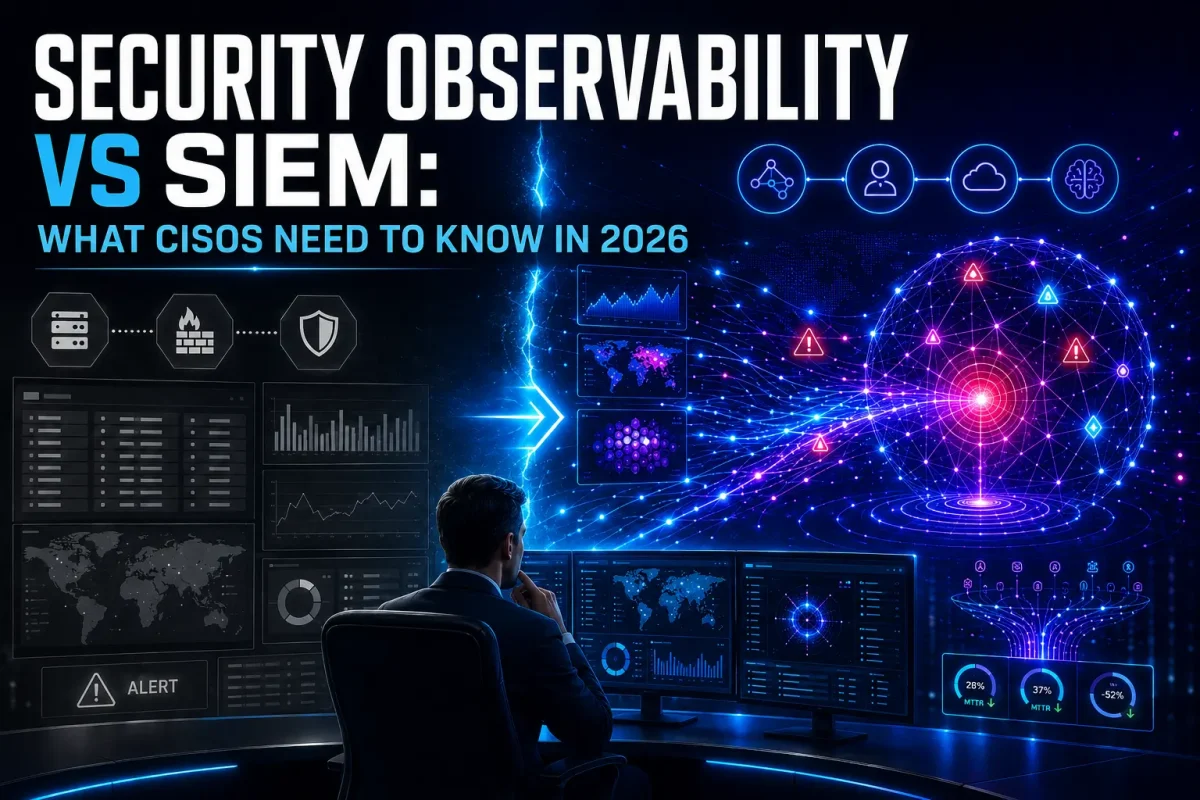

Security Observability vs Traditional SIEM: What Modern CISOs Need to Know in 2026
June 15, 2026
Three Pillars of Observability: Metrics, Logs, Traces
July 6, 2026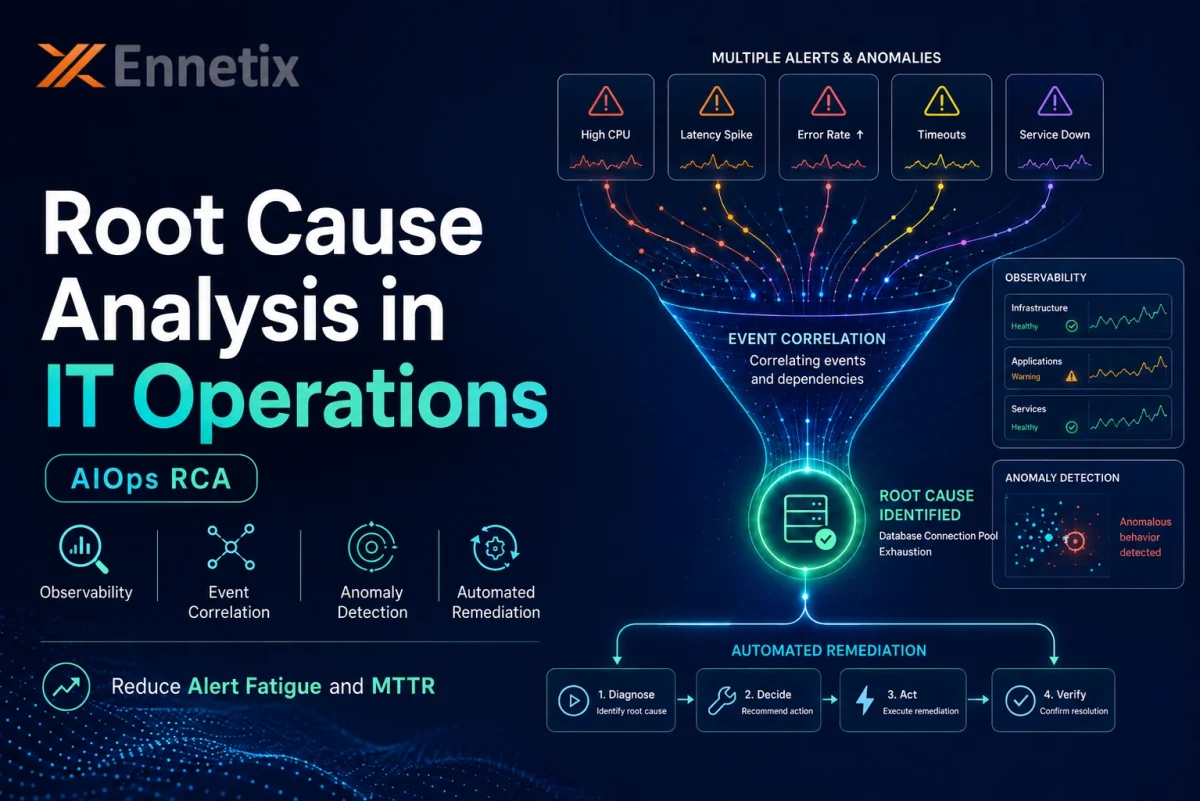
Modern IT environments do not fail in simple, predictable ways. When users report that an application is slow, a network is unstable, or a service is down, the real cause may be hidden across multiple layers of infrastructure.
It could be network latency, a misconfigured cloud resource, an application dependency issue, a degraded API, an endpoint problem, or even a security anomaly. In many cases, several symptoms appear at the same time, making it difficult for IT teams to identify where the issue actually started.
This is where root cause analysis in IT operations becomes critical.
Root cause analysis, also known as RCA, helps IT operations teams identify the real underlying cause of an incident instead of only fixing the visible symptom. When combined with AIOps, observability, event correlation and automated remediation, RCA becomes faster, more accurate and more useful for preventing repeat incidents.
For enterprise IT, network operations, cloud operations and security teams, faster RCA directly improves uptime, reduces alert fatigue and helps lower mean time to resolution.
What Is Root Cause Analysis in IT Operations?
Root cause analysis in IT operations is the process of identifying the actual reason behind an IT incident, outage, performance degradation, or poor user experience.
The goal is not only to restore service quickly. The goal is to understand why the issue happened so that teams can prevent it from happening again.
In IT operations, RCA usually involves:
- Collecting data from affected systems, applications, networks, cloud resources and endpoints.
- Reviewing the sequence of events that led to the incident.
- Identifying the specific component, condition, change, or dependency that triggered the issue.
- Documenting the cause and recommended remediation steps.
- Improving systems and processes to reduce repeat incidents.
Traditional RCA is often manual, slow and dependent on the experience of individual engineers. In complex IT environments, this approach is no longer enough.
Why Traditional Root Cause Analysis Is Slow
Many IT teams use multiple monitoring tools across different parts of the environment. One tool monitors the network, another tracks applications, another collects logs, another handles tickets and another focuses on security alerts.
Each tool shows part of the picture, but none of them may show the complete operational context. This creates four major problems.
1. Too Many Tools and Too Little Context
When an incident occurs, engineers must move between dashboards, logs, alerts, tickets and communication channels. This increases investigation time and delays resolution. Instead of seeing one clear incident path, teams see scattered data points.
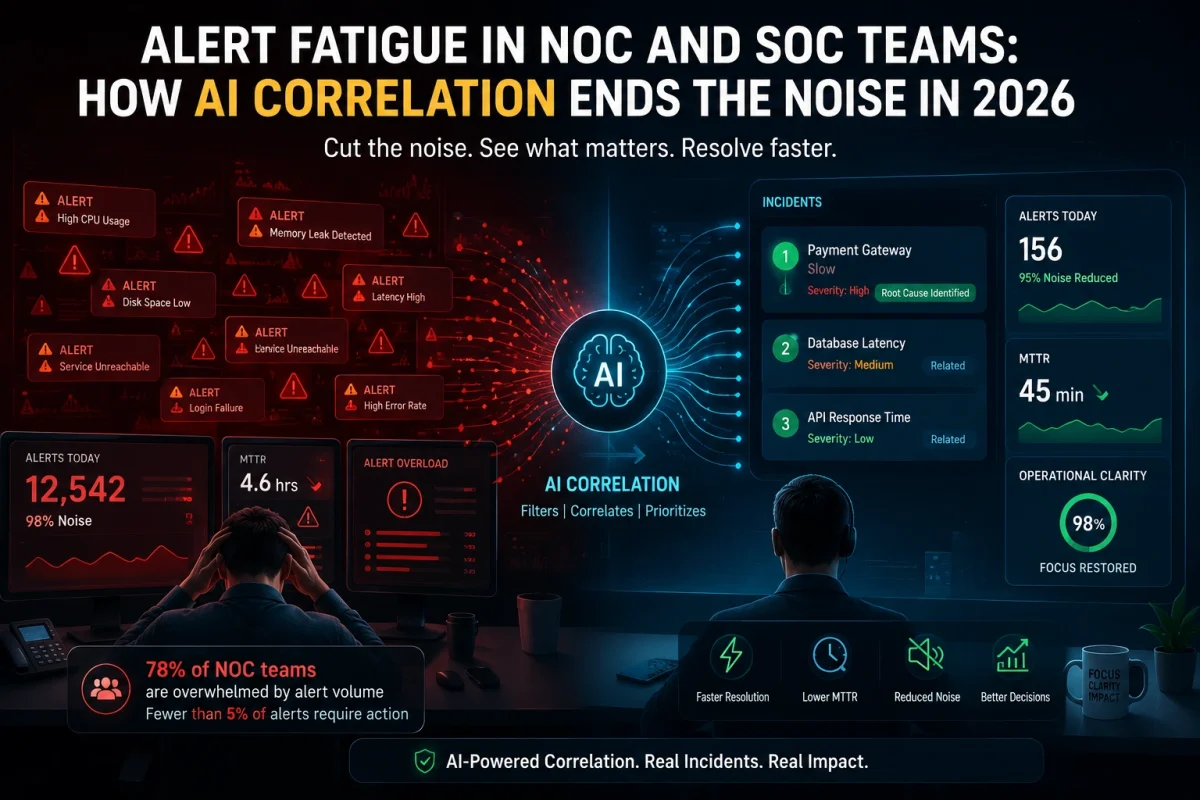
2. Alert Fatigue
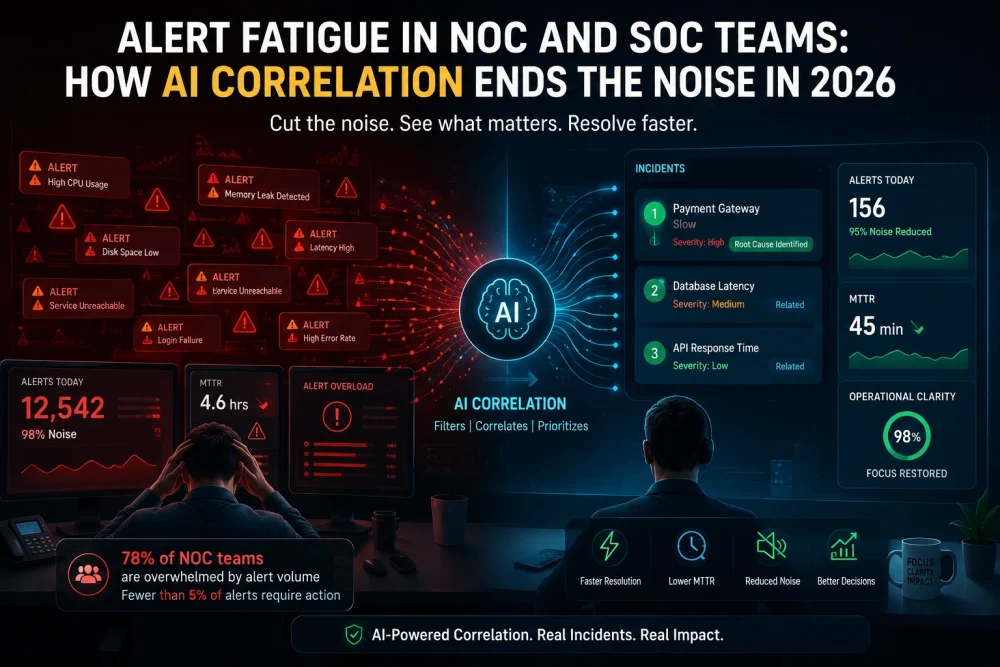
A single infrastructure issue can trigger multiple alerts across network monitoring, application monitoring, endpoint monitoring and security tools.
Without event correlation, teams may see dozens or hundreds of alerts for one root cause. This makes it harder to identify the alerts that matter.
3. Siloed Teams
ITOps, NetOps, CloudOps and SecOps teams often work in separate systems. When there is no shared operational view, teams spend more time coordinating than solving. This slows incident response and increases MTTR.
4. Fixing Symptoms Instead of Root Causes
Without unified visibility, teams often fix what is visible first. They may restart a service, clear an alert, reroute traffic, or close a ticket without addressing the real trigger. The same problem then returns later.
This is why modern organizations are moving from manual RCA to AIOps-driven root cause analysis.
What Is AIOps Root Cause Analysis?
AIOps root cause analysis uses artificial intelligence, machine learning and analytics to detect, correlate and prioritize IT operations data at scale.
Instead of asking engineers to manually stitch together data from multiple tools, AIOps platforms analyze telemetry across infrastructure, applications, networks, endpoints and security systems.
AIOps RCA can help teams:
- Detect anomalies before they become major outages.
- Correlate related alerts into fewer meaningful incidents.
- Identify likely root causes faster.
- Reduce alert noise.
- Improve incident response.
- Support automated remediation workflows.
IBM explains AIOps as the use of artificial intelligence and machine learning to support IT operations tasks such as anomaly detection, root cause analysis, event correlation and predictive analysis.
For Ennetix, this is where xVisor fits. xVisor is built to provide unified observability, AI/ML-powered anomaly detection, multi-dimensional correlation and automated remediation across complex IT environments.
How Event Correlation Reduces Alert Fatigue
Event correlation is one of the most important parts of automated root cause analysis.
Here is a simple example.
A network link between a data center and a cloud application begins to degrade. That one issue may trigger alerts in:
- Network monitoring tools.
- Application performance monitoring tools.
- Endpoint experience systems.
- Security monitoring systems.
- Ticketing tools.
Without correlation, engineers may see multiple separate alerts and start investigating each one individually.
With event correlation, those related alerts can be grouped into one incident with a likely origin point. This helps teams focus on the actual root cause instead of chasing every alert separately.
For Ennetix xVisor, this is a key positioning point: xVisor does not only collect alerts. It correlates operational and security signals so teams can identify the root cause faster.
Root Cause Analysis vs Monitoring vs Observability
Many teams confuse monitoring, observability and RCA. They are connected, but they are not the same.
- Monitoring tells teams that something is wrong.
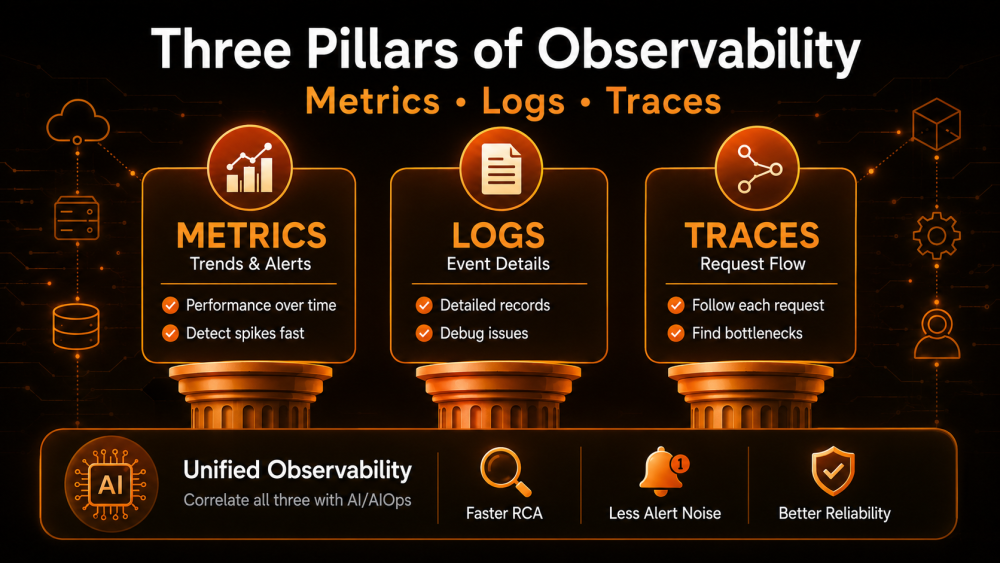
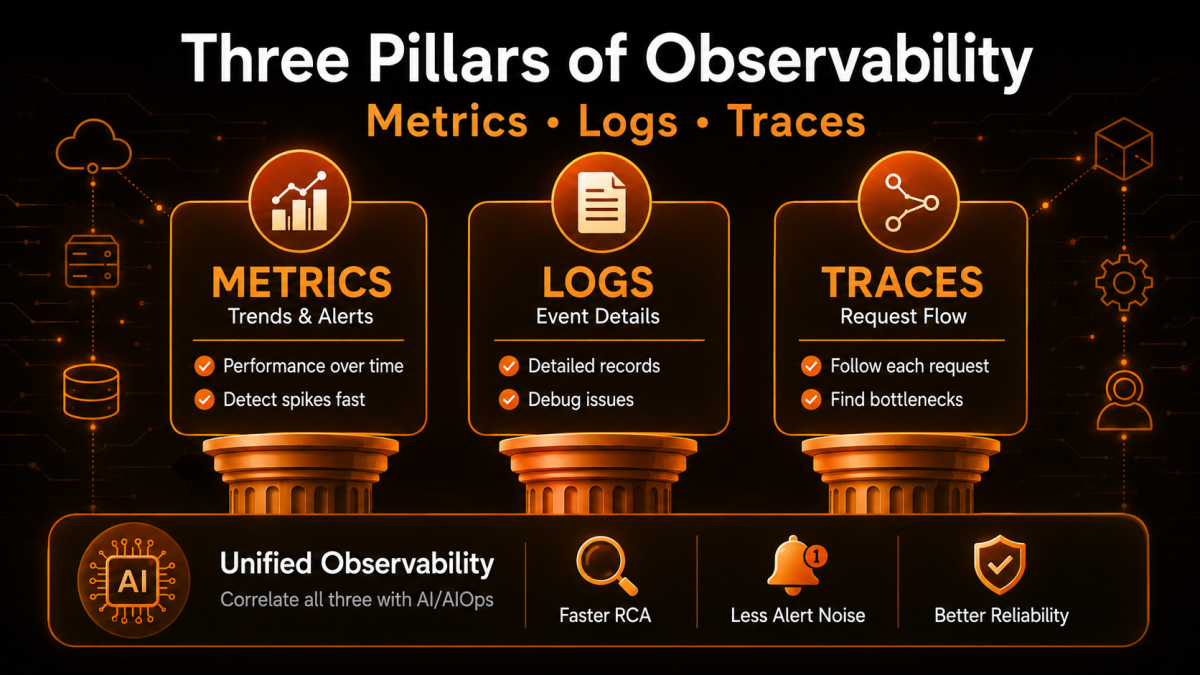
- Observability helps teams understand why something is wrong by providing deeper context across metrics, logs, traces, events, network signals and user experience data.
- Root cause analysis uses that context to identify the actual source of the issue.
A traditional monitoring tool may tell the team that application response time is high. An observability platform can show whether the issue is related to the application, database, cloud resource, network path, endpoint, or security event.
AIOps-driven RCA goes one step further by correlating these signals and surfacing the most likely cause.
Ennetix xVisor Observability Platform is designed to monitor, measure and analyze performance across solution components, helping teams speed up root-cause analysis and address performance and security-related incidents.
How Ennetix xVisor Supports Automated Root Cause Analysis
Ennetix xVisor is an AIOps and observability platform built for IT operations, network operations and security operations teams.
It helps teams move from fragmented troubleshooting to faster, more structured root-cause identification.
Unified Observability Across the IT Stack
xVisor brings together data from networks, applications, cloud infrastructure, services and endpoints into a unified operational view. This helps reduce tool switching and gives teams better context during incidents.
AI/ML-Powered Anomaly Detection
Instead of depending only on static thresholds, xVisor uses AI/ML-driven analytics to detect performance and security deviations in real time. This helps teams identify abnormal behavior earlier.
Event Correlation Across Performance and Security Signals
xVisor correlates alerts, incidents and anomalies across different parts of the IT environment. This reduces alert noise and helps teams identify the likely root cause faster.
Application Delivery Topology
xVisor helps map application and network service dependencies, making it easier to understand how one issue can impact users, services and business applications.
Digital Experience Monitoring
Digital experience monitoring helps teams understand how users and endpoints experience applications and networks. This makes it easier to connect infrastructure problems with real user impact.
ITOps and SecOps Alignment
Many IT incidents today have both performance and security dimensions. xVisor gives IT operations and security operations teams a shared view of performance deviations, anomalies and potential threats.
Automated RCA and Remediation Workflows
Ennetix root cause analysis solution supports faster RCA by helping teams process high volumes of operational data, automate IT event correlation and connect RCA workflows with ITSM and SOAR processes.
From Root Cause Analysis to Automated Remediation
Identifying the root cause is only the first step. The next step is action.
Once the root cause is known, teams need to resolve the incident quickly and prevent the same issue from recurring. This is where automated remediation becomes important.
Automated remediation can help with common actions such as:
- Restarting a service.
- Triggering a support workflow.
- Reallocating resources.
- Rerouting traffic.
- Correcting configuration drift.
- Quarantining a risky endpoint.
- Escalating the issue to the right subject matter expert.
Ennetix automated remediation helps teams move from confirmed root cause to action with less manual intervention. This is important because RCA and remediation should not be treated as separate processes. Accurate RCA makes automated remediation safer and more effective.
Why Faster RCA Matters for Digital Experience
From a user’s perspective, the backend infrastructure does not matter. What matters is whether the application loads, the network responds and the service works.
Every minute of degraded performance can lead to:
- Lost productivity.
- Failed transactions.
- Poor customer experience.
- SLA violations.
- Repeated support tickets.
- Lower trust in IT systems.
Faster RCA helps reduce the duration and frequency of these issues. It also helps IT teams move from reactive firefighting to proactive service assurance.
This is especially important for enterprises, ISPs, universities, government agencies and organizations with distributed users, hybrid infrastructure, cloud systems and security-sensitive environments.
Use Cases Where Root Cause Analysis Matters
Automated root cause analysis is valuable across many IT and security environments.
Network Latency Troubleshooting
When users experience slow applications, the root cause may be packet loss, congestion, routing issues, DNS problems, or endpoint-side conditions.
Application Performance Issues
A slow application may be caused by backend bottlenecks, database delays, API failures, cloud resource limits, or dependency issues.
ISP and Enterprise Network Issues
ISPs and enterprises need faster RCA when one network issue affects multiple users, services, or locations.
Campus and University IT
Universities have complex environments with students, faculty, staff, guest users, online learning systems, research networks and endpoint diversity.
Security Anomalies
Security events often need correlation with performance data, endpoint behavior, network traffic and user activity. This is where threat insights and situational awareness become important.
Remote Workforce Experience
Remote users may face issues caused by home networks, ISP paths, VPNs, endpoints, cloud apps, or identity systems.
In all these cases, the challenge is the same: multiple symptoms, limited time and one root cause that must be found quickly.
Key Benefits of AIOps Root Cause Analysis
AIOps-driven RCA helps IT teams achieve:
- Faster issue detection.
- Reduced alert fatigue.
- Lower MTTR.
- Better visibility across infrastructure.
- Fewer repeat incidents.
- Improved collaboration between ITOps, NetOps and SecOps.
- More accurate incident prioritization.
- Better digital experience monitoring.
- Support for automated remediation.
- Stronger long-term operational decision-making.
Why Choose Ennetix xVisor for Root Cause Analysis?
Ennetix xVisor is built for organizations that need more than basic monitoring.
It is designed for teams that need unified observability, AI-driven anomaly detection, event correlation, root-cause identification and automated remediation across complex IT environments.
With xVisor, teams can reduce manual investigation, improve incident response and move faster from detection to resolution.
For IT leaders, the value is simple: fewer blind spots, faster RCA, reduced operational noise and more reliable digital performance.
Conclusion
Root cause analysis is no longer optional in modern IT operations. It is essential for reducing downtime, improving MTTR and preventing repeated incidents.
Traditional RCA methods are too slow for today’s complex IT environments. Manual log review, siloed monitoring tools and high-volume alerts make it difficult for teams to identify the real cause of incidents quickly.
AIOps changes this process.
By combining observability, anomaly detection, event correlation and automated remediation, AIOps root cause analysis helps teams identify issues faster and act with more confidence.
Ennetix xVisor helps IT operations, network operations and security operations teams move beyond reactive troubleshooting. It brings data together, applies AI/ML-driven analysis and supports faster remediation across complex IT infrastructure.
Explore Ennetix xVisor
Want to identify IT performance and security issues faster? Explore how Ennetix xVisor helps teams improve observability, automated root cause analysis and remediation across complex IT environments.
FAQs
Root cause analysis in IT operations is the process of identifying the actual underlying cause of an incident, outage, performance issue, or degraded user experience. It helps teams fix the real problem instead of only resolving visible symptoms.
Automated root cause analysis uses AI, machine learning and event correlation to analyze IT operations data, detect anomalies and identify likely root causes with less manual investigation.
AIOps helps by collecting and analyzing large volumes of operational data, reducing alert noise, correlating related events and surfacing the most likely cause of an incident.
Ennetix xVisor supports RCA through unified observability, AI/ML-based anomaly detection, event correlation, digital experience monitoring and automated remediation workflows.