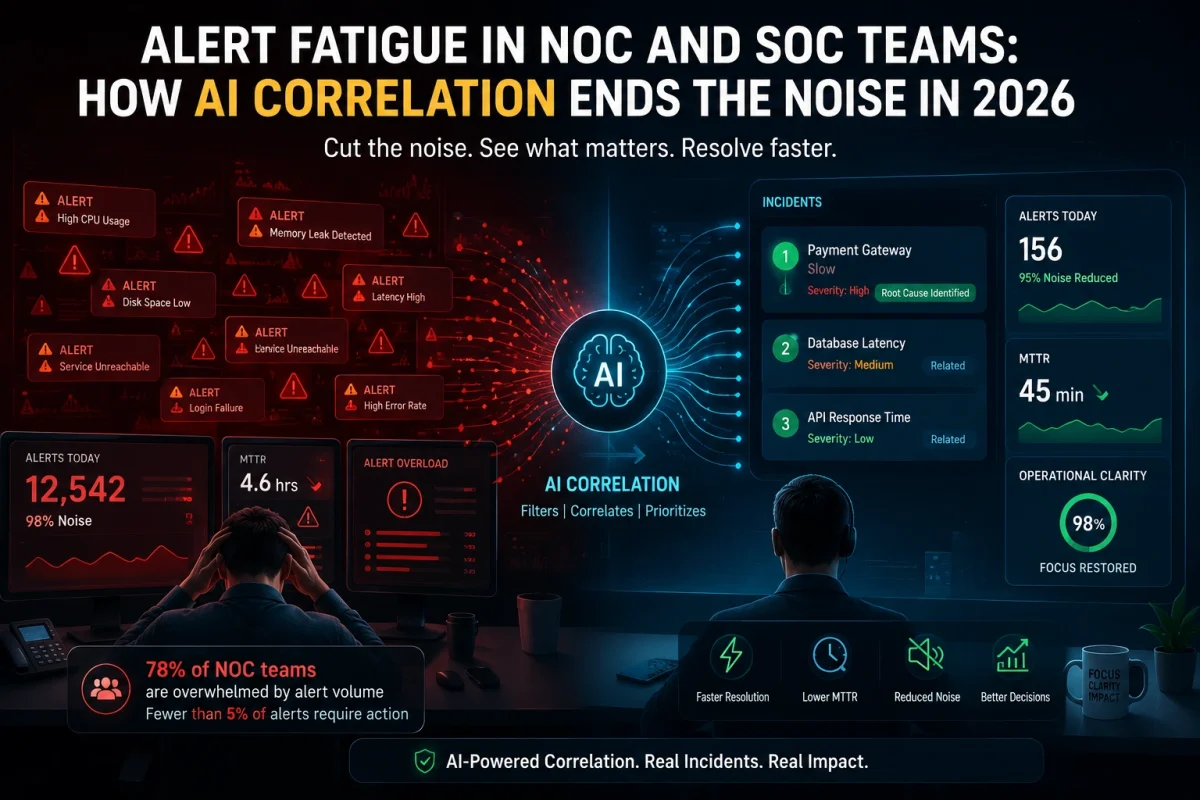

Alert Fatigue in NOC and SOC Teams: How AI Correlation Ends the Noise in 2026
June 5, 2026
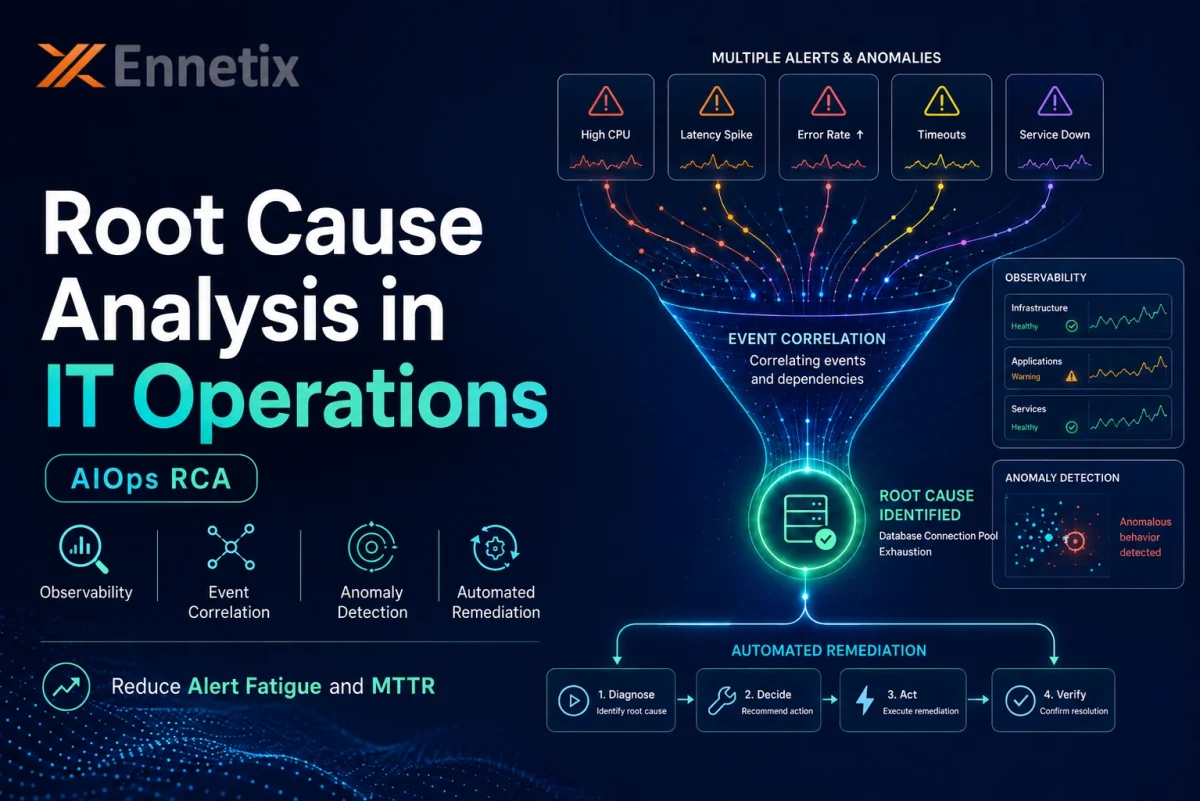
What Is Root Cause Analysis in IT Operations?
June 26, 2026
Introduction: The SIEM Was Built for a Different World
When the first generation of Security Information and Event Management (SIEM) platforms emerged in the early 2000s, the threat landscape was fundamentally different. Attacks were largely external, perimeter-based, and generated clear log signatures that rule-based detection engines could identify. The primary use case was log aggregation and compliance reporting.
In 2026, the threat landscape has changed beyond recognition. The most damaging attacks involve slow, patient lateral movement through authenticated sessions that generate no suspicious logs. Threat actors exploit Shadow IT devices that never touch the log aggregation pipeline. Ransomware operators spend weeks mapping network topology before executing — silently, without triggering any rule that a SIEM would catch.
The question for CISOs is not whether SIEM is useful. It is whether SIEM alone is sufficient — and for most enterprise environments, the honest answer is no.
What SIEM Was Designed to Do — and Where It Falls Short
The Log-Centric Foundation
SIEM platforms are built around log ingestion and normalization. They collect log events from firewalls, servers, identity platforms, applications, and other sources, normalize them into a common format, apply correlation rules, and generate alerts when patterns match known threat signatures or compliance violation indicators.
This architecture has two structural limitations. First, it only sees what generates a log event. Devices that are not configured to send logs — unmanaged endpoints, IoT devices, legacy operational technology, Shadow IT applications — are invisible to the SIEM, regardless of how they behave on the network. Second, it is rule-based by nature. Threats that do not match a known signature or violation pattern are not detected. And the most sophisticated threats are specifically designed to avoid triggering known rules.
The Alert Volume Problem
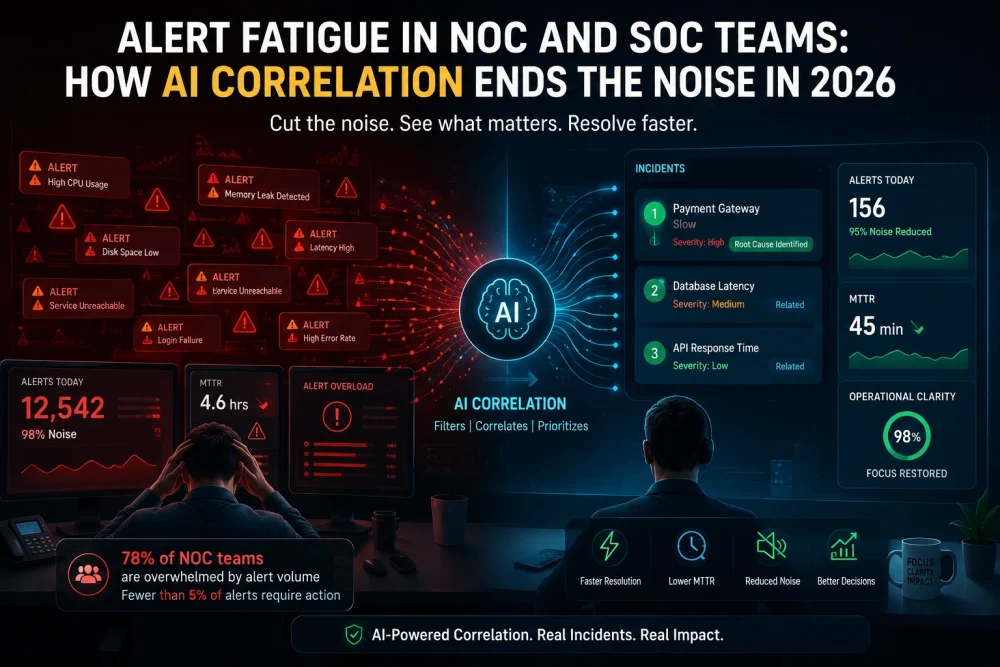
SIEM platforms are also notorious generators of alert noise. As environments scale and threat intelligence feeds expand, SIEM rule sets grow without corresponding increases in alert quality. Security operations teams in large enterprises can receive tens of thousands of SIEM alerts per day — the vast majority of which are false positives, low-priority informational events, or duplicates. The critical incidents are there. They are buried.
The 2026 Deloitte-NASCIO cybersecurity study found that only 22% of CISOs feel highly confident in their ability to protect data — down from 48% in 2022. Alert overload is a significant contributing factor.
What Security Observability Means
Security observability is the capacity to understand the security state of a system by analyzing its behavioral outputs — not just its log events. It asks: what is this device actually doing on the network right now? How does its current behavior compare to its established baseline? Are there communication patterns that are unusual, even if they are not explicitly prohibited?
Behavioral Signals as Security Intelligence
Security observability draws on a fundamentally different class of telemetry. Rather than waiting for a log event to signal a threat, it analyzes network flow data, device communication patterns, application interaction sequences, and user behavioral baselines to identify anomalies that may indicate compromise — even when those anomalies generate no log events at all.
A device that begins making small, frequent connections to multiple internal hosts at 3 AM — consistent with credential harvesting or lateral movement preparation — may generate no SIEM alerts. It has not violated any rule. But its behavior on the network is clearly anomalous relative to its established baseline. Security observability platforms detect this.
The Network Layer as the Primary Intelligence Source
The network is the one environment that every device must traverse. An attacker who has compromised an endpoint, bypassed an identity control, or exploited a Shadow IT application still generates network traffic. That traffic is observable — and it contains behavioral signatures that distinguish malicious activity from legitimate operations.
According to Ennetix platform research, one-third of successful cyberattacks now originate from Shadow IT. These devices and applications are outside the SIEM’s visibility entirely. They are visible on the network. Network-centric security observability closes this gap.
Security Observability vs. SIEM: A Practical Comparison
Capability | Traditional SIEM | Security Observability |
Primary data source | Log events | Network telemetry + behavioral signals |
Detection approach | Rule-based / signature matching | AI-driven behavioral anomaly detection |
Shadow IT visibility | None — requires log configuration | Full — analyzes all network traffic |
Unknown threat detection | Limited — misses novel patterns | Strong — detects behavioral anomalies |
Alert volume | Very high — significant noise | Reduced — AI correlation and baselining |
Compliance reporting | Strong | Complementary, not primary |
MTTR impact | Moderate | Significant — faster root cause context |
What CISOs Should Ask When Evaluating Security Observability
- Does the platform provide visibility into unmanaged devices, IoT endpoints, and Shadow IT applications through network telemetry — without requiring agent installation?
- How does the platform handle encrypted traffic? Does it perform metadata analysis without decryption, and what is the coverage of encrypted east-west traffic?
- Does the platform integrate with existing SIEM and SOAR investments, feeding enriched, correlated incidents rather than replacing them?
- How quickly does the platform establish behavioral baselines in a new deployment, and how does it handle legitimate changes to normal behavior over time?
- What compliance frameworks does the platform support, and how does it generate audit-ready reporting?
Conclusion: Security Observability as a CISO Strategic Priority
SIEM is not obsolete. For compliance reporting, log aggregation, and detection of known threat signatures, it remains a valuable component of the security stack. But it is an incomplete defense against the threat landscape of 2026.
Security observability — grounded in network telemetry, behavioral baselining, and AI-driven anomaly detection — closes the gaps that SIEM structurally cannot address: Shadow IT visibility, behavior-based lateral movement detection, and early warning indicators that precede any log event.
For CISOs building toward genuine cyber resilience rather than compliance-checkmark security, security observability is not an upgrade to the existing stack. It is a missing layer that changes what the stack can see.
To learn how Ennetix's xVisor platform delivers these capabilities from real-time anomaly detection to unified performance and security observability, schedule a personalized platform demonstration with the Ennetix team.
FAQs
Traditional SIEM relies on log ingestion and rule-based correlation to detect known threat signatures — it can only see what generates a log event. Security observability goes a layer deeper, analyzing network telemetry, device communication patterns, and behavioral baselines to detect anomalies even when no log event is triggered. The key distinction: SIEM tells you what was logged; security observability tells you what is actually happening on the network, including from unmanaged endpoints and Shadow IT devices that SIEM never sees.
Security observability is not a SIEM replacement — it is the missing layer SIEM cannot provide. SIEM remains valuable for compliance reporting, log aggregation, and detecting known signatures. But it has structural blind spots: unmanaged devices, IoT endpoints, and encrypted lateral movement that generate no suspicious logs. Security observability platforms like Ennetix xVisor close these gaps by analyzing all network traffic and feeding enriched, AI-correlated incidents back into existing SIEM and SOAR investments — reducing alert noise without replacing the compliance stack.
The 2026 Deloitte-NASCIO cybersecurity study found that only 22% of CISOs feel highly confident in their ability to protect data — down sharply from 48% in 2022. A major driver is alert overload: enterprise environments can receive tens of thousands of SIEM alerts per day, the vast majority of which are false positives or low-priority noise. Meanwhile, the most damaging attack patterns — slow lateral movement through authenticated sessions, Shadow IT exploitation, pre-ransomware network reconnaissance — are specifically designed to avoid triggering SIEM rules, leaving critical threats buried or invisible entirely.
Security observability uses the network layer — which every device must traverse — as its primary intelligence source. It establishes behavioral baselines for every device and monitors for deviations: unusual connection frequency, unexpected east-west traffic, off-hours communication patterns. A device performing credential harvesting or lateral movement at 3 AM may violate no SIEM rule, but its network behavior is detectably anomalous. According to Ennetix research, one-third of successful cyberattacks now originate from Shadow IT — devices entirely invisible to SIEM but fully observable on the network. AI-driven anomaly detection catches these threats before any log event is generated.